

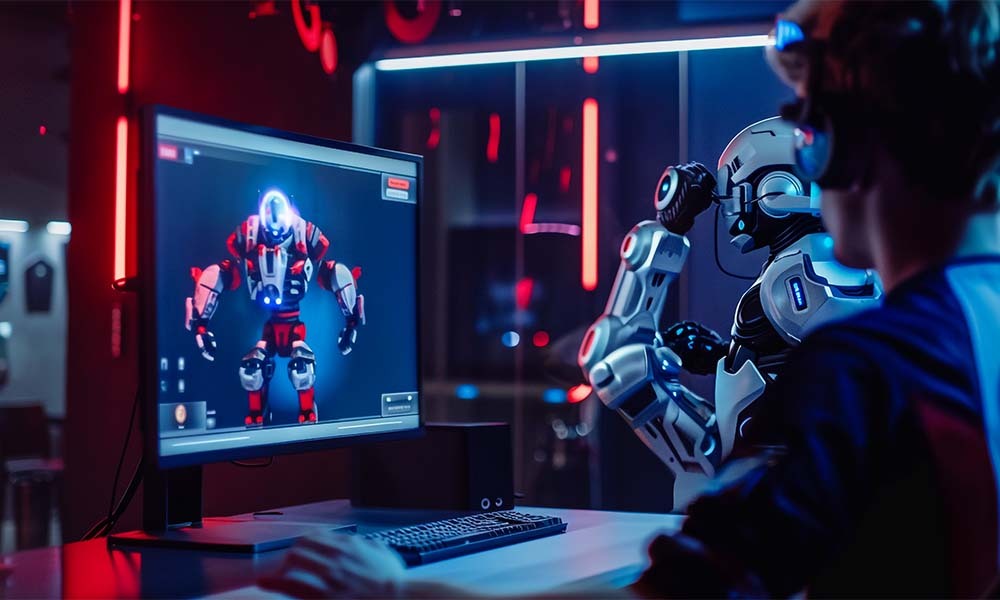
The global AI in gaming market size exceeded USD 3.2 billion in 2024 and is expected to cross USD 51 billion by 2033. The substantial shift in growth is the result of the growing use of AI technology and tools in the gaming industry. It helps enhance visuals and performance, and allows deep personalization and adaptive gameplay.
As time passes, Artificial Intelligence is breaking out of its traditional boundaries and redefining the whole gaming sector. This relationship between AI and gaming has been going on for decades, but what we see today is more than just an evolution; it is a complete reinvention of how games are built, played, and experienced. From smarter NPCs to procedural worlds, advanced details, faster developments, and real-time storytelling, AI is pushing the limits of everything. Whether you are a gamer, a developer, or a business working with a game development company in USA, understanding the future of AI in gaming is essential to staying ahead of the curve.
Today, we are here to help you do just that and more. We will explore how AI is transforming the gaming experience, the current and future applications of AI systems, and how artificial intelligence is becoming a reliable partner in next-gen game development.
Brief Evolution of AI in Video Games
AI in games is not new. If you must know, it can be traced back to early 1950s chess and checkers programs. It got even more significant in the 1970s with the introduction of games like Pong and Space Invaders. As AI got more powerful, it started becoming a part of nearly every game, including Pac-Man, The Legend of Zelda, and eventually real-time strategy, role-playing games, MOBAs, etc.
Fast forward to today, AI can make real-time decisions, learn from players’ gameplays, adapt behavior on the go, generate procedural content, personalize entire gaming worlds, and more. The use of AI in games has evolved from a simple feature to a core building block of modern game development.
Technologies That Power Up AI in Games
There are four main pillars that enable the use and advancement of AI in games and game development. This allows AI to make the game learn, adapt, and evolve in different ways. Here is more about them:
- Deep Learning Neural Networks: Enables pattern recognition, generative asset creation, system learning, and behavior analysis.
- Adaptive Learning: Allows game engines to learn through trial and feedback and adapt like human players.
- Generative Models: Procedural and other content generation models make it fast and easy to build worlds, art, characters, music, and storylines.
- Predictive Analytics: Use data and information to adjust difficulty and personalize gameplay in real-time.
- Game Engine and Middleware: Several tools, like Unity and Unreal, have AI features built in that make it much more accessible and scalable.
These technologies and frameworks are what make the base of AI integration in games and shape smarter and faster developments.
How AI Is Transforming The Gaming Experience?
One of the most exciting transformations is the focus toward player-centric gameplay, where AI builds the experience based on the player’s behaviors. Here is how is AI used in video games.
-
Smarted NPCs
Once limited to repeated responses, different queues, and pre-set rules, NPCs or non-player characters are becoming more responsive and dynamic with the help of AI. AI-driven NPCs can also follow patterns, but can also exhibit emotional responses, dynamic conversations, adaptive combat, learning behavior based on past behavior, and realistic survival instincts.
Games like GTA V, Red Dead Redemption 2, Middle-earth: Shadow of Mordor, The Last of Us Part II, Alien: Isolation, STALKER, F.E.A.R., and more use AI in different ways to enhance the overall experience. Things like enemies using names and reacting to falling comrades, unpredictable behavior, tactical working, and dynamic world simulations, like in these games, make the games amazing and more immersive.
-
Personalized Experience and Gameplay
AI not only helps in development but also affects players’ experience and the game itself. It can help the system collect and interpret gameplay to create tailored experiences that adapt to each player. This allows difficulty, missions, and challenges to be adjusted in real-time based on performance and behavior. Moreover, the predictive models help improve engagement, and the collected data can help enhance the game further.
For example, Candy Crush Saga and Red Dead Redemption 2 feature adaptive difficulty. This is one of the most significant examples of how AI is transforming the gaming experience.
-
Predictive Gameplay and Behavior Modeling
Another big way AI is transforming game development and games is through predictive gameplay mechanics and behavior reading. Modern AI can read through thousands of user interactions and predict preferred play style, possible moves, risk-taking patterns, and exploration vs aggression likelihood. This can not only narrate the gameplay but also the conversations and different interactions.
Some of the biggest examples include StarCraft II, Clash Royale, and Justice Online Mobile. This helps developers create deeper and more intuitive experiences, which also ultimately increases engagement and retention.
-
Procedural Content Generation (PCG)
Creating expansive game worlds, complete levels, rich characters, diverse music, and beautiful art has always been a difficult process. Enter AI, and it has now become much more simpler, easier, and seamless. AI can help generate worlds, levels, quests, scripts, weather, terrain, details, soundscapes, and more.
For example, the entire universe in No Man’s Sky is built through AI algorithms. This not only eases developers’ work but also helps generate multiple ideas in a short time.
Different AI Features Modern Game Studios Use to Enhance Games
To get a sneak peek of the future, let’s take a look at where we stand today. Here is a brief review of how AI is used in video games currently.
1. Pathfinding Algorithms
Many games use AI to calculate distances and routes for characters. A* or A-Star is a favorite tool among game builders, but modern and new ML-driven systems are being introduced that allow for smarter and more realistic navigation.
2. Enemy Behavior Systems
AI also helps in-game enemies to strategize better, communicate with each other, ambush the player, and retreat when low on health. This and many more interactions and dynamic behavior make the gameplay unpredictable.
3. Procedural Level Generation
Many games, especially roguelikes, RPGs, and open-world titles, use AI to arrange maps, dungeons, and puzzles. This increases replayability through unique, randomly generated content, developer efficiency through automation, and enhanced player experience.
4. Quality Testing and Assurance
AI tools help simulate millions of gameplay scenarios and test multiple things at once. It helps detect bugs, stress-test mechanics, and optimize performance. This speeds up the development timeline for everyone, whether you are solo or with a game development company in USA.
5. Player Support and Moderation
Game studios have also started integrating AI chatbots and moderation tools that keep things clean and fair in the game. It can check and help control toxic behavior, cheats, hacking, and ensure safe multiplayer environments.
6. Graphics and Animation
AI can help upscale textures, generate animations, and enhance facial expressions without motion capture. Moreover, it can also enhance the sensory dimension and improve how games look, sound, and feel, especially in XR environments.
What The Future Looks Like For AI In Gaming?
The next decade will be crucial and fundamental for AI in gaming. It may totally reshape Artificial Intelligence for games, and the future appears incredibly promising. Here are some major advancements that you can expect.
-
Fully-Intelligent NPCs
Imagine playing a game in which NPCs remember past encounters, instill opinions about players and others, develop relationships with other NPCs, and change their behavior according to the world around them. These living characters will create unpredictable yet immersive gameplay where every gameplay feels unique.
As we move forward, NPCs may even have emotional intelligence, internal motivations, different fears, dynamic alliances, rivalries, and real-time decision-making. This will completely alter RPGs, survival games, open-worlds, and shooters, especially.
-
AI-Driven Game Masters
You can think of AI-driven game masters as superheroes looking after the game. It can craft new story arcs, modify quests, adjust pacing, tweak narrative, generate characters, and shift world conditions. This means giving freedom to the game, so the story never repeats.
AI Dungeon is a great example of this. It is a text-based game and shows a small glimpse of what’s possible. Moving forward, the future AAA games will push these mechanics and features even farther.
-
Metaverse Worlds
Expect to see great improvements in the future metaverse and its dependence on AI. The power of ML and AI will help populate worlds, generate environments, personalize experiences based on players’ gameplay, manage economies, and moderate interactions. Every metaverse world will have the ability to self-sustain, reducing the need for people to manage it.
Moreover, players may get to see intelligent avatars, digital humans, dynamic content, hyper-personalization of experience, higher accessibility, and better infrastructure. Also, AI will help make the world more secure and stable.
-
Hyper-Realistic Animations and Graphics
AI, ML, and other AI integrations will help automate several things for ease of developers and development companies. Although AI is helping in this regard already, it will further improve automated character animation, facial mapping, environment graphics, lighting and world simulation, and motion synthesis.
This will give time to developers and creators to spend more on creativity and avoid repetitive tasks. Soon, AI may even create realistic crowd movements, weather systems, and natural animal behavior.
-
AI As A Helping Hand In Development
Anyone who thinks AI will replace actual developers is oblivious to this whole concept. AI was never meant to replace developers; it was built to collaborate with them. In the future, AI will help development teams by suggesting level layouts, planning missions, generating assets, optimizing codes, composing music, balancing mechanics, and testing gameplays.
In short, Artificial Intelligence will become a creative partner. It will enable faster, better, innovative, and more imaginative production cycles. Ultimately, it will lead to better games (hopefully!).
-
Real-Time Physics and Simulations
Advancements in AI will allow game companies to simulate different things. These include fluid dynamics, real destruction, fire spread, ecosystem interactions, and even plant and life growth. These systems will not remain pre-scripted and will evolve naturally as the game progresses.
The different tools for this are game engines like Unreal Engine and Unity, AI frameworks like NVIDIA Physics NeM and PyBullet, and world model AI like Google DeepMind’s Genie 3. This will enhance gameplay and make it more immersive for players.
AI in Multiplayer Games
AI is helping not just in single-player games but also in multiplayer and competitive games. Moving forward, competitive gaming will feel more dynamic thanks to advancements and innovations in AI. Here are some of them.
-
Smart Matchmaking
AI can analyze far more than just win or loss ratios. It can evaluate recent performances and behavior patterns to match players with similar play style, aggression, rank, performance, risk tolerance, and reactions.
-
Anti-Cheat Systems
AI-powered cheat and security systems are becoming more sophisticated, robust, and powerful. They learn from patterns rather than rules and deeply analyze gameplay to filter out cheaters, hackers, or smurfs.
-
Better AI Bots
Finally, AI is helping bots get better and actually useful, and moving forward, expect to see better AI bots. Future co-op games or vs. bots games may include AI players that understand objectives, support the team, execute smart strategies, and communicate naturally. This will change cooperative gaming forever.
Final Takeaway
Whether you are building a 3D game or getting a 2D game development service, AI can be of huge help. Over 60% of game developers use AI tools to improve gameplay mechanics, and 72% of new games in 2023 used AI-driven procedural generation.
The fusion of Artificial Intelligence and video games marks one of the most creative periods in gaming history. AI is not just helping improve existing systems, but also producing ideas and strategies, enabling new forms of gameplay, storytelling, and immersion that were once impossible. From lifelike NPCs to intelligent engines, from AI-assisted development to deep testing, AI for games is reshaping everything. Moving forward, the future of AI is quite bright. There is great room for improvement, and who knows what is yet to come.